
Cambodia is located in the continent Asia. It has Thailand and Laos to the north, Vietnam to the east, Malaysia to the south, Myanmar to the west and northwest.
The capital is Phnom Penh.
The official language is Khmer.
The climate is governed by the monsoon winds, which then defines two seasons. From mid-May to early October, the strong prevailing winds of the southwest monsoon bring heavy rains and high humidity. From early November to mid-March, the lighter and drier winds of the northeast monsoon bring variable cloudiness, infrequent precipitation and lower humidity.
The staple foods are rice, fish, coconut, sweet potatoes, beef, pork, baby tomatoes, string beans, pineapple and so much more (https://www.moon.com/travel/food-drink/all-about-traditional-cambodian-food/).
https://www.britannica.com/place/Cambodia
CAMBODIAN NOODLES (https://www.thegardenercook.com/cambodian-noodles/):
- 1 package Cambodian Noodles
- TBSP roasted peanut oil
- 1 red bell pepper, cored and thinly sliced in ¼-inch strips
- 3 carrots, thinly sliced in ¼-inch strips, lengthwise
- 2” piece ginger, peeled and finely chopped or grated
- 1-2” piece lemongrass, smashed
- 2 cloves garlic, finely chopped
- 1 TBSP tamari or soy sauce
- ½ tsp salt
- 1 to 4 C vegetable broth, as desired
- 1 baby bok choy, thinly sliced
- 8 to 12 garlic chives, cut 1-inch long
- 1 to 2 serrano peppers, thinly sliced (optional)
- Juice of 1 lime
- Prepare the noodles as directed on the package.
- Heat the oil in a medium pot over medium-high heat.
- Add the red bell peppers, carrots, and ginger.
- Cook until the vegetables are beginning to caramelize and let off some of their natural oil (It will be a red-orange color).
- Add the lemongrass and garlic and continue cooking another 2 minutes.
- Add the tamari, salt, vegetable broth, bok choy, garlic chives, and hot pepper and bring to a simmer.
- Place the noodles in a bowl.
- Pour the liquid over the noodles.
- Arrange the vegetables over the noodles, removing the lemongrass stalk.
- Add the lime juice.
- Serve hot.

Here is how my noodles turned out. I am allergic to bell peppers and peppers in general, so did not use them, but still the flavors were amazing!!
STICKY RICE LAYER CAKE (https://www.thespruceeats.com/sticky-rice-layer-cake-3217373):
- 1 C glutinous rice flour
- 2/3 C tapioca flour, available at health food stores, or Asian/Chinese food stores
- One 13-1/2oz can plus ¼ C coconut milk
- Pinch salt
- ¾ C white sugar
- 2 tsp coconut flavoring
- 4 drops red food coloring, or other colors of your choice
- ¼ C shredded coconut, for decoration, optional
- Combine flours together in a large mixing bowl.
- Add the salt and sugar and stir everything together.
- Add the coconut milk plus the coconut flavoring.
- Stir well by hand, or with electric beaters on low speed. I find a hand whisk works just fine.
- Once you have a fairly smooth batter, pour half of it into another bowl.
- Add a few drops of red food coloring to one of the bowls and stir to create a pink batter (or choose another color or colors according to your preference).
- Grease a loaf pan with a few drops of cooking oil) a glass one works well so you can see the layers as you add them, but it’s not necessary).
- Place the loaf pan in a steamer, if you have one. If not, a flat-bottomed wok or large soup-type pot also works, as long as your loaf pan can fit inside it (I used a flat-bottomed wok for mine). You will also need a lid that will fit over both the loaf pan and the pot/wok.
- Pour some water into your steamer, or into the bottom of the pot or wok (around the loaf pan) – it should be at least 1 inch deep. Don’t make the water too deep, or there will be too much splashing when it boils.
- Now pour roughly 1/3 of one color of batter (either pink or white) into the loaf pan. You can choose to make the layers think or thick – anywhere from ¼ to ½ inch of batter is good.
- Bring the water to a bubbling boil, then reduce heat so that it is gently boiling around the loaf pan (If you’re using a wok or pot, the boiling water may make the loaf pan rattle a little).
- Cover the pot or wok/steamer with a tight-fitting lid so the cake can steam-cook.
- Steam for five minutes, or until the batter is firm to the touch.
- Then add your second layer on top. Tips: the second and subsequent layers will take slightly longer to cook – from 8 to 10 minutes, depending on the heat of your steamer.
- Cook until the middle of the cake is as firm to the touch as the outside. The cake will also rise slightly as it cooks. Also, be sure to add water to your steamer or wok/pot every 10 minutes or so.
- Continue adding layers and steaming the cake in the same way until nearly all the batter is used up.
- For the final layer, I like to add a few extra drops of red coloring to create a darker, contrasting top. Tips: It’s better to overcook rather than undercook this cake (if you undercook some of the layers, they will turn out too soft and the cake won’t hold together when sliced). Also, note that the middle of the cake may ripple towards the end – that is normal. The rippling effect will subside once it has cooled, and you won’t notice it once the cake is sliced up.
- When cake is done cooking, remove the loaf pan from the steamer and allow it to cool at least 10 minutes.
- After it has cooled, place in the refrigerator.
- Chilling it will help firm up so that slicing will be easier.
- When cake is cold, run a butter knife around the outside of the pan, then turn pan over and use the knife and your hands to nudge the cake out.
- To slice it, use a sharp, non-serrated knife and one smooth slicing motion from the top downward (try not to use too much of a sawing motion). You can simply serve this cake in slices or cut out shapes, such as diamonds or squares.
- Serve at room temperature.
- Enjoy!!
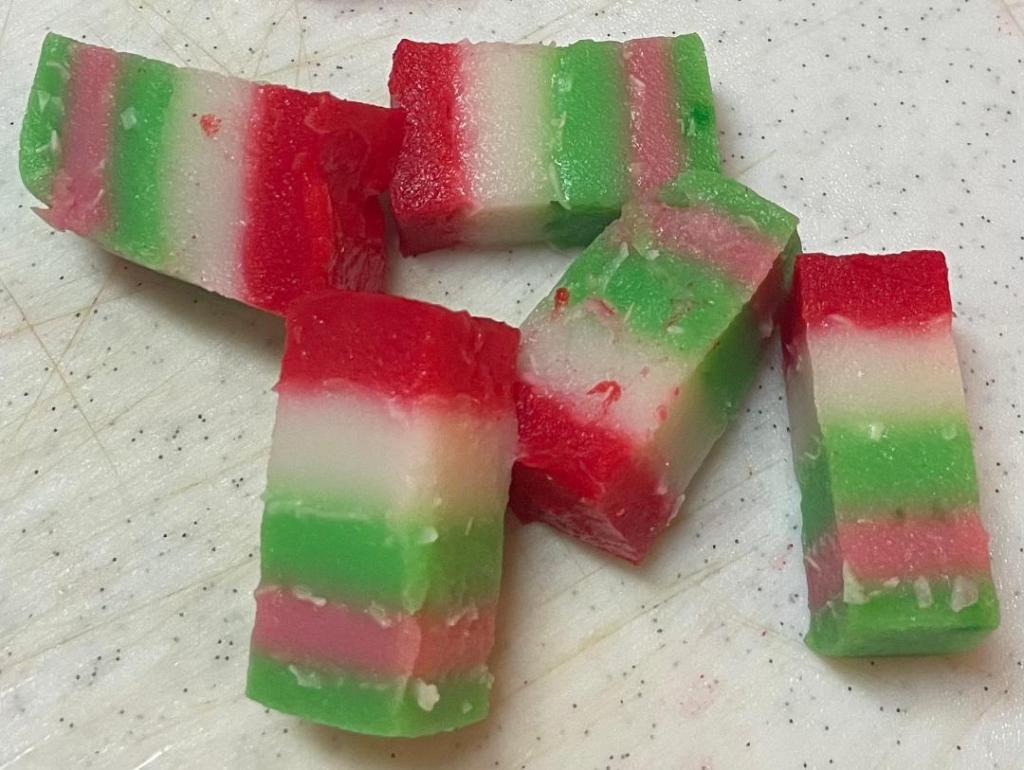
This was the first time I have ever made this and I must admit they turned out really delicious!!! I added shredded coconut into the batter. Very good!!
 Travel Global Food