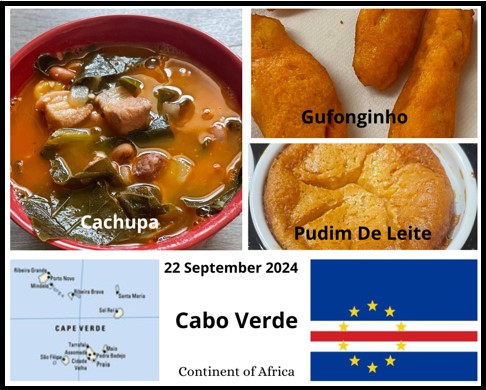
Cabo Verde (or Cape Verde) is located in the continent of Africa. It has the Atlantic Ocean to the north, Western Sahara and Morocco to the northeast, Mauritania, Senegal and Mali to the east, The Gambia, Guinea-Bissau, Guinea, Sierra Leone and Liberia to southeast, The Atlantic Ocean to the south and to the west.
The capital is Praia.
The official language is Portuguese.
The climate is characterized by stable temperatures with extreme aridity. February is the coolest month, and August and September are the hottest and wettest months.
The staple foods are corn, beans, rice, fried potatoes, cassava, carrots, kale, squash, lobster, tuna, chicken, grilled pork, eggs and much more (https://en.wikipedia.org/wiki/Cape_Verdean_cuisine#:~:text=Corn%20and%20beans%20are%20staples,chicken%2C%20grilled%20pork%20and%20eggs).
CACHUPA (Traditional Stew) (https://www.crumbsnatched.com/cachupa-traditional-dish-of-cape-verde/#recipe):
- 1-1/2lbs. corned beef brisket, cut into chunks
- 1lb. salt pork, cut into large chunks
- 2 TBSP crushed garlic, divided
- 2 tsp white wine vinegar, or apple cider vinegar
- 1 bay leaf
- 1 tsp smoked paprika
- 1 tsp salt
- ½ tsp black pepper
- 2 TBSP olive oil
- 1 medium onion, chopped
- 1-2 bouillon cubes, extra large
- 2 tsp tomato paste
- 18 C water
- 1-1/2 dried yellow hominy, or samp
- ½ C dried rock beans, or pinto beans, soaked overnight
- ½ C dried cranberry beans, soaked overnight
- 2/3 C large white dried lima beans
- 1 large yuca
- 4 C chopped collard greens, rinsed and chopped
- 1lb. linguiça, or chouriço, (spicy, smokey sausage) sliced into rounds
- Season the corned beef and salt pork the night before with the vinegar, bay leaf, smoked paprika, salt, pepper and 1 TBSP of crushed garlic.
- Let the meat marinate in the refrigerator overnight.
- Heat the olive oil over medium heat in a large stockpot and add the chopped onions, and the other TBSP of garlic.
- Transfer the bay leaf from the seasoned meat to the pot.
- Saute the onions until they are fragrant.
- Add the marinated meats to the pan (in a single layer if possible) and let the meat brown for about 10 minutes (5 minutes on each side).
- Remove the meat from the pan and set aside.
- Add 1 bouillon cube and the tomato paste to the pot and whisk until the bay leaf has dissolved and the tomato paste is smooth.
- Add the meat back to the pot and add the water. The water level should reach the handles of the pot.
- Cover the pot with a lid.
- Bring the pot to a boil and thoroughly rinse the hominy and add to the pot.
- Let it reach a boil again, and then turn the flame down to low.
- Cover the pot with the lid and simmer for 1 hour.
- Check on the hominy every 30 minutes to give it a stir and make sure that there is plenty of water (it helps to have a kettle of boiling water on hand throughout the cooking process, so you can add more water at any point if needed. Use cold water).
- After the first hour is up, add the feijão pedra (rock beans) and cranberry beans to the pot, stir and cover it again with the lid.
- Stir and check the water level every 30 minutes. The liquid will thicken as it cooks.
- Once the second hour is up, remove the meat from the pan (if desired), and shred it by lightly pressing a fork against the meat. Feel free to discard any fat that gets detached from the salt pork.
- Add the meat back to the pot, stir it again and add the fava beans, yuca, and greens (if the greens are too bulky, add about half the greens at first, then let them cook for 10 minutes and then add the rest).
- Let everything cook for about 45 minutes.
- Add the chouriço, let it cook for about 20 minutes.
- At this point you want to stir and taste the cachupa.
- Add another bouillon cube if desired.
- Let everything simmer for another 10-15 minutes.
- Turn off the flame and let the cachupa rest (covered) for 20-30 minutes.
- Ladle into bowls and serve.
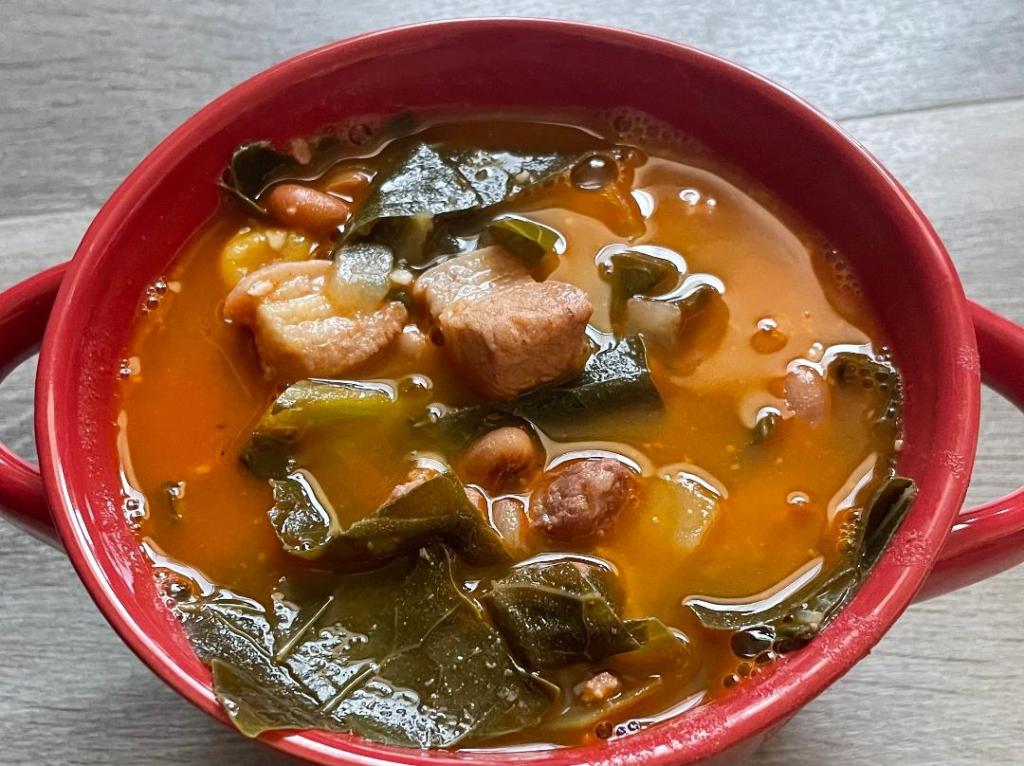
This stew has so much flavor!! I enjoyed it a LOT!!
GUFONGINHO (Cape Verdean Sweet Potato Gufong) (https://www.crumbsnatched.com/cape-verdean-sweet-potato-gufong/#recipe):
- 3 large, sweet potato, peeled and diced
- 4 C of pre-cooked fine yellow cornmeal (you may or may not use all of it)
- ¼ C granulated sugar
- 2 tsp baking powder
- 2 TBSP all-purpose flour
- 1 tsp salt
- 4 C canola or vegetable oil for frying
- Boil the diced sweet potatoes until they can be easily pierced with a fork.
- Combine the boiled sweet potatoes with the salt, sugar, and baking powder in a food processor (you may need to work in batches if your food processor is small).
- Transfer the processed mixture to a very large mixing bowl.
- While the mixture is still hot, add the all-purpose flour and gradually add the cornmeal.
- Mix with your hands as you go. The mixture should feel like Play-Doh once it’s all mixed together, but not be so dry that it falls apart while you are rolling it.
- Try rolling a small amount and add more cornmeal if the dough is too sticky. You may not use all the cornmeal, it’s ok if you have a small amount left over.
- Rub a small amount of oil between your palms and roll each gufong (2 TBSP of the mixture at a time) into a log/hot dog shape.
- Set the gufong on a plate and repeat until you have rolled out all of the gufong (there will be 40-50 of them).
- Keep the dough and the rolled gufong covered with a damp cloth prior to frying them, so they don’t dry out.
- Heat the oil in a deep pot of Dutch oven, until it reaches 325F.
- Drop 6 gufong into the oil at a time and fry them in batches until they are deep golden color (about 4 minutes per batch).
- The gufong should be firm on the outside when they come out of the oil, and the centers will be warm and soft. They will firm up slightly as they cool.
- Cool the gufong on a wire rack and serve them while they are fresh.
- Gufong can be stored at room temperature in a paper bag or in a bowl covered in foil. They are best when eaten within 2 days.
Notes: Gufong can be re-heated in the oven or wrapped in a damp paper towel and microwaved for 30 seconds.
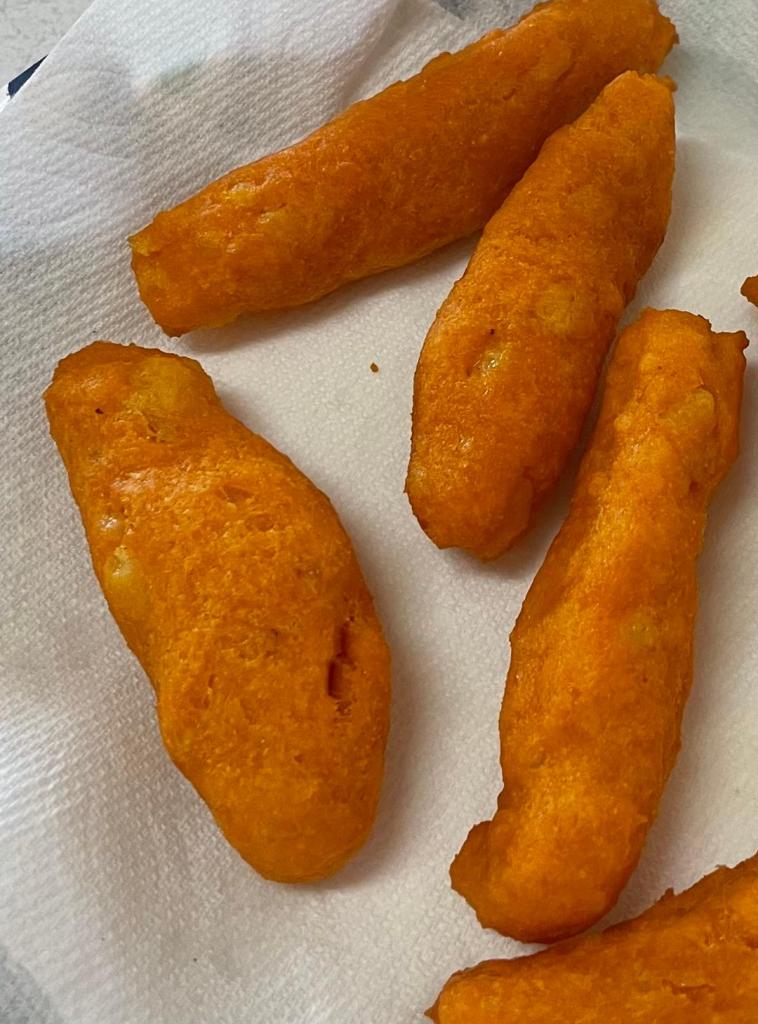
These made a good bread-like side dish for the stew!!
PUDIM DE LEITE (Cape Verdean Style Flan) (https://www.crumbsnatched.com/pudim-dleite-cape-verdean-style-flan/):
Pudim:
- 14oz. can sweetened condensed milk
- 12oz. can evaporated milk
- 4 whole eggs
- 2 egg yolks
- 3 TBSP heavy cream
- 2 tsp vanilla extract
- ½ tsp salt
Caramel Syrup:
- 1 C sugar
- ½ tsp salt
- 4-6 C boiling water (for the water bath)
- Preheat the oven to 350F.
- Start by heating 1 C of sugar in a shallow pan.
- Spread it out in an even layer and use a rubber spatula to stir over medium-low heat. The sugar will start to turn brown and clump together.
- Continue to stir occasionally until it liquifies and turns amber in color. This generally takes about 15 minutes. Make sure to watch it carefully so it does not burn.
- Pour it into an 8-inch round baking pan as soon as you remove the caramel from the flame.
- Tilt the pan so that the caramel covers the bottom of the pan in an even layer.
- Allow the caramel to harden.
- Then combine the condensed milk, evaporated milk, whole eggs, egg yolks, vanilla extract, heavy cream and salt in a blender.
- Blend on high speed for 30 seconds.
- Place the baking pan with the hardened caramel in the center of a deep roasting pan.
- Pour the boiling water into the roasting pan, around the baking pan. The water should come about halfway up the baking pan.
- Once the caramel has cooled and hardened, I spray a paper towel with a little bit of cooking spray and use the paper towel to grease the sides of the pan so the pudim does not stick to the sides while baking.
- Pour the milks mixture into the baking pan, over the hardened caramel. Use a mesh strainer to filter out any bits of egg (there really shouldn’t be any).
- Put the baking dish into the oven and bake the pudim for 60 minutes.
- The pudim should be jiggly and resemble the texture and color of an omelet when it’s done. The center should be firm and will have a slight springiness if you touch the center with your finger.
- Put the baking dish in the water bath for 15 minutes, and then remove the pan and let it sit on the counter for about 1 hour.
- Once the pudim is at room temperature, let the entire pan cool in the refrigerator for about 4 hours or overnight.
- Let it sit on the counter for about 15 minutes and run a butter knife around the sides of the pan to loosen the pudim.
- Place a dish over the pan and invert it. If the pudim does not release right away, try tapping the bottom of the pan.
- The pudim should release and the caramel syrup will run down over the sides.
- There will be some hardened sugar left in the pan, this is completely normal, and it can be discarded.
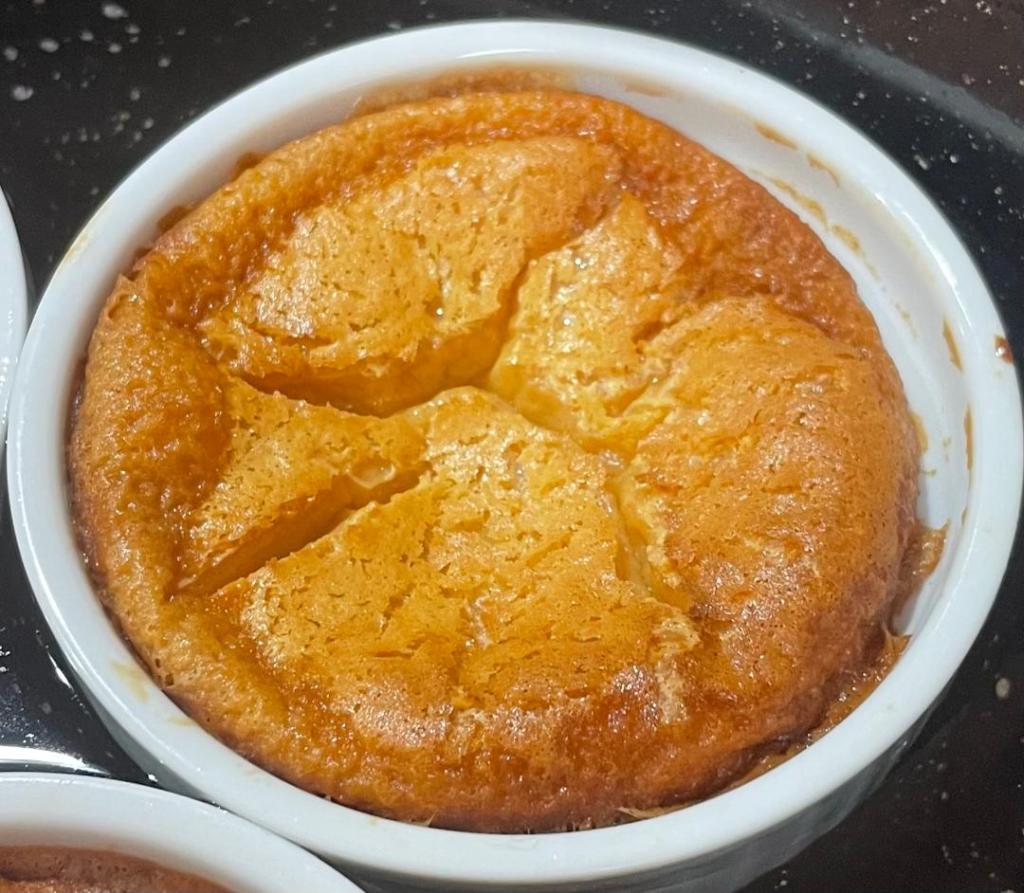
Oh my these were good!!! Next time I may use the larger ramekin!!
 Travel Global Food